Friday, September 4, 2015

Girl Meets Course-Correction


Girl Meets World got good. What gives?


Wednesday, July 29, 2015

A Dream Cast for the CW's New Gritty Dystopian Little Women Adaptation

In case you haven't heard (you poor thing), the CW is developing a TV show based on Little Women. And the description... well, I'd say it defies words, but it's made of words, so just read it:
Written by [Alexis] Jolly, Little Women is described as a hyper-stylized, gritty adaptation of the 1868 novel by Louisa May Alcott, in which disparate half-sisters Jo, Meg, Beth, and Amy band together in order to survive the dystopic streets of Philadelphia and unravel a conspiracy that stretches far beyond anything they have ever imagined – all while trying not to kill each other in the process.
Every time I think I know how I feel about that description, it turns out I was wrong. Am I horrified? Excited? Anxious? Confused? I have no idea! All I know is one thing: This show absolutely must be made real. I don't know that a gritty, dystopian Little Women TV show is something that needed to happen, but now that the idea's out there, it had better happen. And it honestly has a better shot--both at being picked up and at being good--on the CW, a network that is currently experiencing something of a golden era of female-driven shows, literary adaptation shows, and genre shows, than it would on any other channel.

While we wait to see what happens, though, my sister and I have decided to prod the CW along with the widely-recognized gold standard of anticipatory fannish activity: a fantasy cast. So look no further, dear reader; you have found the One True Gritty Dystopian Little Women Cast Line-Up.


Emily Kinney as Meg March

http://assets-s3.usmagazine.com/uploads/assets/articles/80404-emily-kinney-talks-shocking-walking-dead-midseason-finale-plot-twist/1417464924_emily-kinney-zoom.jpg 

The eldest of the March sisters, Meg provides stability, kindness, and a guiding hand, while hiding an independent streak behind a strong sense of propriety. Kinney has proved herself more than capable of playing a sweet character with a steel spine--and her trademark is bringing sympathy and warmth to a gritty, post-apocalyptic setting setting.


Lindsey Morgan as Jo March


Second child Jo March, the lead of the book, is the wild card of the March family. She's smart, loud, brash, has zero sense of propriety, and is the least warm and nurturing of the four March sisters. And she has a serious temper. But she would do anything for her family. People who've seen The 100 (I know you're out there!) will recognize that as a pretty spot-on description of Morgan's character Raven Reyes. It'd be a wrench to lose her from that show, but she'd kill on Little Women.


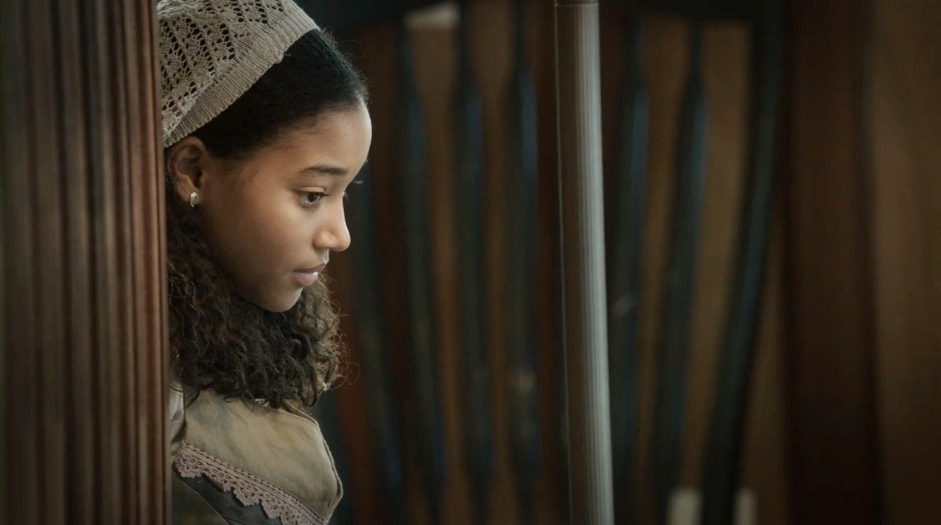
Amandla Stenberg as Beth March


Beth is the quietest of the March sisters. Sweet, generous, and incredibly family-oriented, her rebellious streak shines through only when she's standing up on behalf of someone else. Stenberg's been adding quiet humanity to brutal post-apocalypses since 2012.


Kiernan Shipka as Amy March
 
http://i.imgur.com/ljCHfMy.jpg 

Youngest child Amy is self-obsessed, a little bit vain, and cares a lot about appearances--but without the same understanding of propriety that Meg has. She's impulsive and self-centered, but when her sisters set her straight, she'll do the right thing. Because Amy, like all the March sisters, does care deeply about family. Alone of the four actresses playing the March sisters, Shipka did not make her name in a post-apocalyptic movie or show. But she did a phenomenal job on Mad Men portraying a young girl growing and maturing in a restrictive society.


Susanna Thompson as Marmee


Marmee was the original rebel of the March family--that's where her daughters got it from. She loved her children fiercely, and wanted the world for them, but she respected their independence above all else. And she never believed that their gender should hold them back. Thompson has played more than one ferocious mother in her time, and fans of the CW's Arrow should have no trouble imagining her as the March matriarch. Moira Queen may be more cut-throat than Marmee, but the family dedication is definitely there.


John Cho as John Brooke

http://www.dramafever.com/st/news/images/Selfie_1.png 

John Brooke is Meg's love interest, a sweet, solid, studious, and upstanding man of limited means. John Cho is amazing, makes everyone who watches his shows want to hug him, and needs to be in more things. No-brainer.


Ian Harding as Theodore "Laurie" Laurence


Laurie starts out the book as an impetuous, spoiled, but ultimately good-hearted friend of the March family. Unfortunately, after Jo turns down his marriage proposal, he runs off to be a shithead playboy in Europe. Various unhappy and spoilery events finally calm him down, and he comes back to the fold as a wiser man, but he's a divisive character, to say the least. Luckily, Harding has half a decade's experience bringing charm and genuine likeability to a slightly skeazy character on Pretty Little Liars. (Plus, CMU alumni REPRESENT!)


JR Bourne as Professor Bhaer


The other leg of Jo's love triangle, Bhaer is an incredibly smart man who, due to his immigrant status, can't get the kind of work he deserves in America. He is staid, but tender, and Jo is drawn to him because he treats her as an intellectual equal. Like all "other legs" of love triangles, a sizeable portion of the fanbase hates him, but whatever. Anyway, Bourne's ace at calm-but-intense, and he's attractive and likeable enough that the CW might be able to overlook the (canonical!) age difference

Sunday, June 21, 2015

Gender Disparity in American Showrunners: Another Descent into Excel Madness

A couple of years ago, I published an in-depth look at the gender make-up of British and American TV writing staffs, with a particular emphasis on sci-fi/fantasy shows. In that case, I was looking for data to justify yelling about Steven Moffat. Alas, the data did not bear me out on that one, so I was forced to yell about Steven Moffat for other reasons.

Anyway, since then I've thought a lot about the kinds of entertainment questions that can be answered with publicly available data. It probably shouldn't have taken me two years to get from "gender disparity in writing staffs" to "gender disparity in showrunners," but in my defense, "Day of the Doctor" aired three months after that post, and the frothing rage it inspired sort of blasted everything else out of my mind.

But I've now mostly recovered, so I decided to do a deep dive into the gender make-up of American showrunners. And as an extra-special Father's Day gift to my dad, who believes I would be the most popular blogger in the world if I would just cut down on the f-bombs, I will not swear a single time.

The Study

I looked at every primetime, scripted show that aired on an American broadcast network (ABC, CBS, the CW, Fox, or NBC) in the 2014 - 15 season. This left out reality shows and soap operas. For each show, I recorded the names of its showrunner(s), whether it had at least one female showrunner, and whether it had at least one male showrunner. My data was gathered from Wikipedia and several dozen (probably over one hundred) interviews and news articles.

Studies should have specific questions going in. In keeping with the sci-fi/fantasy theme of my 2013 study, mine were: What percentage of American TV shows have at least one female showrunner? Are some networks more gender-equal than others? Are some genres more gender-equal than others?

Definitions

"Showrunner" is an uncredited role on American television productions. The showrunner, usually credited as an executive producer, is in charge of the day-to-day running of the show--as you might expect. This also generally makes them the ultimate authority on the creative direction of the show; they decide on long-term plotlines, assign and revise scripts, and incorporate notes from executives.

Because most shows have numerous executive producers, figuring out which one is the showrunner when you are unfamiliar with the show can be a tricky business. Showrunners are often, but not always, the creator of the show. In the end, I just googled extensively. If a preponderance of news articles/interviews named a person as a showrunner, I went with that. I used a combination of names and publicly available photos to determine gender. This is not a 100% foolproof system, but it's the best I have.

As always, the full data set is available for those interested: https://docs.google.com/spreadsheets/d/1dEHsyl4yJOgpXthrbJdSdr7UiHdWdOK6pfpWvLGYB2k/edit?usp=sharing

The Breakdown

Edit: A concerned reader pointed out that my tables are less than clear. (Thanks, concerned reader!) To clarify: The second column in each table lists the number of shows in each category; the third column lists the number of shows with at least one female showrunner in each category; the fourth column lists the number of shows with at least one male showrunner in each category; and the final column lists the percentage of shows with at least one female showrunner (that is, female showrunner shows divided by total shows) in each category. The third and fourth columns may sum to more than the total number of shows, because some shows have more than one showrunner.

Network
# Shows
# w/ Female SR
# w/ Male SR
% w/ Female SR
ABC
24
12
15
.5
CBS
24
4
21
.167
The CW
11
6
7
.545
Fox
17
4
15
.235
NBC
17
2
15
.118
Total
93
28
73
.301


Genre
# Shows
# w/ Female SR
# w/ Male SR
% w/ Female SR
Comedy
35
8
29
.229
Procedural
21
2
19
.095
Drama
19
11
11
.579
Sci-Fi/Fantasy
18
7
14
.389
Total
93
28
73
.301


So...?

So, 30.1 percent--or slightly less than 1/3--of American network primetime scripted shows have a female showrunner. Meanwhile, 78.5 percent--just over 3/4--of shows have a male showrunner. (Those numbers don't sum to 100 because some shows have multiple showrunners.)

Obviously, those aren't great numbers. Three times as many shows have a male showrunner as have a female showrunner, On the other hand, they're not unexpected numbers; in my 2013 writers room study, I found that the average American show had a writing staff that was 33.4 percent female. And the actual ratio--that is, the total number of credited female writers on American television, divided by the total number of credited writers--was .317, which is extraordinarily close to the showrunners number.

In some ways, that's good news. TV writers' rooms act as a kind of training ground for showrunners; most showrunners have put in at least a few years writing for someone else's show before they're handed the reins of their own. If 31.7 percent of TV writers are female, and 30.1% of showrunners are female, that's an indication that showrunners are drawn with relative gender equality from the pool of qualified TV writers.

Of course, that just means that the problem for women isn't getting out of the writers' room--it's getting into it.

What About Those Network and Gender Questions?

Right! Well, I'll start with genre. Right off the bat, you can see what I'm going to call our "problem genres": comedy and procedurals. Meanwhile, dramas are the best out of any genre, and do better than any individual network; they have total gender equality. Sci-fi/fantasy, my old frenemy, rides the fence; 38.9 percent of SFF shows have a female showrunner, which is juuuuuust above the average.

The networks show a starker divide. ABC and The CW both have 50 percent or more of their shows with a female showrunner; all the other networks have less than 25 percent, with NBC showing an especially dismal 11.8 percent.

Correlation is not, of course, causation, but if I had to hazard a guess, I'd say that the network numbers go a long way toward explaining the genre numbers. ABC and The CW, the two networks with the best gender equality, account for 13 of the 18 SFF shows, and they account for all of the SFF shows with a female showrunner. CBS, meanwhile, the second-worst network, accounts for 2/3 of all procedurals--the worst genre. Though it is possible, I suppose, that networks are first specializing in genres, and then the gender biases of the genres are determining the networks' make-up, the reverse seems more likely.

But again, correlation is not causation. That SFF number is interesting to me, because back in 2013, SFF shows were also just slightly above the average in terms of female writers--but at the time, SFF shows were much more spread out among the five networks. Also interesting: CBS has only two dramas, but those dramas both have female showrunners. And among procedurals, only CBS has any female showrunners.

There are methods by which we might try to suss out the causation, but unfortunately, they rely on us having more data than we do. The fact that there are only two shows that are both dramas and on CBS makes it difficult to figure out how "drama" interacts with "CBS."

But... But Conclusions!

Fine, fine, you can have conclusions. No matter what the causation, it's still a fact that ABC and The CW are doing better than the other networks in terms of gender equality. And it's a lot easier for a network--a defined entity with a relatively small number of decision-makers who regularly communicate--to enact purposeful change than it is for a genre to do so. So if we want more gender equality among showrunners, the thing to do seems to be to applaud ABC and The CW, both with words and with viewership. Make an effort to watch shows with female showrunners, and then write publicly about why you're doing so.

Now, go out there and watch TV!

Thursday, May 14, 2015

Five Things About Elementary 3x24, “A Controlled Descent”

1.  Elementary is about to tell the last important story it will ever tell. Or, more accurately: Elementary may be about to tell the last important story it can ever tell. The threat of relapse has been looming over Sherlock’s story since season one, but it can only be deployed effectively once. This is the last major shift that can happen in these characters’ lives organically; after this, it’s almost inevitable that Elementary will have to work harder and harder to raise the stakes, as nearly all procedurals eventually do. On the other hand, Sherlock’s relapse has the potential to be a phenomenal story. Elementary has always shone when it dealt with addiction, and never more so than in season three. I am excited (and anxious) to see what happens in season four.

2.  After the first half of this season’s return to strong arc-based storytelling, the second half has been a disappointment. Andrew’s death and Joan’s subsequent emotional upheaval were promising (if not particularly original) narrative ground, but though Elementary never exactly abandoned that thread, it never really went anywhere with it, either. I had hoped that Joan’s story would come to a head in the season finale, but it was never mentioned at all, so I guess “One Watson, One Holmes” is the end of that arc. That’s unfortunate, since it was the clearest serialized story of the back half of season three, and without a connection to it, Sherlock’s relapse seems to come out of nowhere. Or, not exactly nowhereElementary has been laying a lot of character groundwork for it this season, mostly while the audience was looking in the other direction—but it does feel disconnected, which draws away from the impact of what is otherwise a good story decision. For instance, Alfredo’s abduction would have worked a lot better as a motivator if he’d been in more than two episodes this season.

3. Just so we’re clear, Sherlock’s relapse = the original Holmes’ Reichenbach Falls. Obviously. I mean, the episode is called “A Controlled Descent.” Elementary is not the kind of show where the main characters can fake their deaths, so they had to get metaphorical about it. I was so sure we were going to get Moriarty when I saw the title.

4. Speaking of which: MORIARTY MORIARTY MORIARTY MORIARTY MORIARTY. Come on, Natalie Dormer, what’s Game of Thrones giving you? Prestige? Cable salary? Awesome clothes? Elementary can give you the 5,000 people in the world who scream in joy when they hear your voice.

5. As a standalone episode of television, “A Controlled Descent” is good, but doesn’t break the top five of the season. (In chronological order: “Bella,” “The Illustrious Client”/“The One That Got Away,” “For All You Know,” “One Watson, One Holmes.”) I haven’t tried watching them back-to-back yet, but I’d bet it’s exquisite if viewed as a distant sequel to “For All You Know.” Together, they form a two-sided view of Sherlock-as-addict (the harm he did to others, and the harm he and others did to himself), and provide an emotional context for his relapse.